ElectronVibe

ElectronVibe 2026

with

Here’s your chance to engage with leading electric utilities, and propose your solutions as an answer to their problem statement(s). Scroll down to find out more.

Time left to apply

Days
Hours
Minutes
Seconds

ElectronVibe 2025 Champions

BSES Rajdhani Power Limited (BRPL) Winners

Limelight IT

FlexEdge turns every AC, EV charger, and factory motor into DOSCOM’s AI-driven virtual power plant—delivering instant, measurable negawatts on demand

Gujarat Urja Vikas Nigam Ltd (GUVNL) Winners

Smartgrid Analytics Pvt Ltd​

AI-driven digital twin platform for optimal planning and control of multi-duration BESS at 11 kV to stabilize the grid.

Pravāh

ML-powered forecasting and control to modernize electricity grids worldwide.

CPC Analytics
(Spinoza Consulting LLP)

AI and Machine Learning-powered fraud detection system for Indian utility companies, that proactively flags suspicious readings and prevents electricity fraud before bill generation

Program Overview

The program designed based on a specific problem statement defined by our partner electric utilities

Andhra Pradesh State

BSES Rajdhani Power Limited (BRPL)

BSES Rajdhani Power Limited (BRPL) Track

BSES Rajdhani Power Limited (BRPL)

Problem Statements

Enabling Renewable Energy and EV Charging Integration through Real-Time Low-Tension Network Visibility 

What is the Problem? 
As rooftop solar adoption and electric vehicle charging grow across Delhi, the ability to safely and confidently connect new distributed energy resources (DER) and EV charging infrastructure to the network is becoming increasingly important. Whether a feeder or distribution transformer has sufficient available capacity to accommodate a new connection depends on understanding current loading conditions in real time — yet this is exactly the kind of visibility the network currently lacks at the low-tension (LT) level. 
Real-time visibility into network conditions largely ends above the distribution transformer level. Below that point — at the feeder and transformer level — there is limited granular data on loading, voltage, and asset health. Assessing whether new DER or EV charging connections can be safely accommodated therefore becomes a manual, time-consuming exercise, rather than something supported directly by existing data. 
Smart meters, while effective for billing purposes, are not a cost-efficient solution for deployment at the density required to close this visibility gap. Their design is optimised for accurate, periodic billing at the customer endpoint rather than continuous, network-wide monitoring, making them disproportionately expensive for this specific purpose. 
Closing this visibility gap also creates value beyond DER and EV integration. The same real-time data can support more effective asset health monitoring at the feeder and transformer level, and faster identification and localisation of outages — which today are often identified through customer complaints rather than direct network signals. 
There is a need for a cost-appropriate sensing and monitoring layer — distinct from smart meter infrastructure — purpose-built to deliver real-time visibility at the LT network level, supporting confident integration of renewable energy and EV charging alongside stronger asset management and faster outage response. 

Strengthening Revenue Integrity through AI-Driven Detection of Tariff Misclassification and Preferential Tariff Misuse 

What is the Problem? 
Distribution utilities classify consumer connections into different tariff categories — residential, commercial, and special categories such as preferential EV charging tariffs — each priced according to the intended use of the connection. Accurate classification is central to revenue integrity, but verifying that a connection's actual usage matches its declared category is not straightforward. 
In some cases, a connection's consumption pattern may not match its declared tariff category. Identifying these mismatches today relies largely on manual review or exception-based investigation rather than systematic analysis of consumption data. 
A more specific version of this problem exists for preferential tariffs designed for EV charging. These tariffs are priced significantly lower than standard residential or commercial rates, intended specifically to encourage EV adoption. There is a risk that connections registered under this category are used substantially for purposes other than EV charging. Confirming this requires more than category-level anomaly detection — it requires disaggregating energy usage at the appliance level to verify that registered EV charging connections are genuinely being used predominantly for that purpose. 
Smart meters already collect granular interval consumption data for most connections. This data is not currently being systematically analysed to detect either category-level mismatches or appliance-level usage patterns, representing an opportunity to extract considerably more value from data that is already being collected. 

Solutions could include:

  • Low-cost, retrofittable sensing devices for the LT network that can be installed without requiring network shutdowns, providing real-time current, voltage, or loading data at the feeder and transformer level. 
  • Network headroom assessment tools that use real-time loading data to support faster, more informed decisions on new DER or EV charging connections. 
  • Asset health and loading monitoring platforms that track distribution transformer and feeder conditions over time, flagging risk of overload or degradation. 
  • Digital twin or visualisation platforms that give grid operators a real-time, granular view of LT network conditions. 
  • Outage detection and localisation tools that use granular network data to identify and pinpoint faults faster than current complaint-driven methods. 
    • Analytics and dashboard layers that aggregate sensor data into actionable insights for distribution network operators. 
  • AI/ML-based classification models that flag tariff category mismatches by comparing load shape, time-of-use patterns, and seasonal consumption trends against expected profiles for each tariff category. 
  • Non-Intrusive Load Monitoring (NILM) techniques that disaggregate appliance-level signatures from aggregate meter data, specifically to verify EV charging behaviour against declared usage. 
  • Anomaly detection and prioritisation platforms that flag connections warranting further investigation, ranked by confidence level and potential revenue impact. 
  • Investigation support dashboards that present flagged cases to revenue assurance teams along with the underlying consumption evidence supporting each flag. 

Andhra Pradesh State Track

Andhra Pradesh Central Power Distribution Corporation Limited (APCPDCL)

Andhra Pradesh Eastern Power Distribution Company Limited (APEPDCL)

Andhra Pradesh Southern Power Distribution Company Limited (APSPDCL)

Andhra Pradesh Power Generation Corporation Limited (APGENCO)

Transmission Corporation of Andhra Pradesh Limited (APTRANSCO)

Non-conventional Energy Development Corporation of Andhra Pradesh Limited (NREDCAP)

Problem Statements

Enabling Intelligent Planning and Optimisation of Battery Energy Storage Systems to Maximise Grid Stability and Renewable Energy Integration 

What is the problem? 

As renewable energy penetration increases across India's grids, Battery Energy Storage Systems (BESS) are increasingly being deployed to manage intermittency and support grid stability. In Andhra Pradesh, utilities are planning to introduce BESS at multiple levels of the power system — at substations, at the distribution feeder level, and at renewable generation sites. However, most BESS installations operate on fixed charge-discharge schedules set at commissioning. These schedules do not adapt to real-time conditions — changes in renewable generation output, load fluctuations across feeders, or grid frequency signals. The result is that storage often charges or discharges at the wrong time, missing the moments where intervention would have the greatest impact on grid stability or cost. The full value of a BESS investment is therefore rarely realised in practice. 

Battery degradation compounds this problem. The long-term health of a BESS asset is shaped by how it is operated — cycle frequency, depth of discharge, temperature exposure, and rest periods all affect capacity retention over time. Without models that track these parameters together and recommend operational adjustments, batteries degrade faster than projected, replacement costs arrive sooner than planned, and utilities lose confidence in storage as a dependable grid asset. 

The need is for intelligent software that sits on top of existing and planned BESS infrastructure — optimising dispatch in real time, predicting degradation trajectories, and giving operators the visibility to manage storage assets across their full lifecycle.

Enabling Accurate Forecasting and Flexible Grid Operations to Manage Renewable Energy Variability Across Andhra Pradesh 

What is the problem? 

As solar and wind capacity grows across Andhra Pradesh, grid operators face increasing difficulty matching supply with demand in real time. Renewable generation is inherently variable — output changes with weather conditions, time of day, and season — and this variability creates scheduling and balancing challenges that require a new class of forecasting and flexibility tools working across the entire power system. 

On the generation side, short-term forecasting of solar and wind output remains limited. Without reliable predictions of when and how much renewable energy will be available, operators must make procurement and dispatch decisions with significant uncertainty. This leads to either over-reliance on expensive balancing power or the risk of supply shortfalls when renewable output drops unexpectedly. 

On the demand side, Andhra Pradesh's grid serves a diverse mix of consumer classes — including large agricultural, industrial, and residential loads — each with distinct and often poorly modelled demand patterns. This variation makes feeder-level demand difficult to predict reliably. Better demand characterisation at the feeder level would allow operators to plan dispatch more effectively and reduce the risk of asset overloads during peak demand periods. 

On the supply flexibility side, thermal generation units serve as the primary balancing resource when renewable output is low. However, the ability of thermal plants to ramp down and absorb renewable surpluses is constrained by technical minimum load requirements. Where these minimums are high, renewable energy may need to be curtailed even when it is available, reducing the overall efficiency of the grid's decarbonisation effort. Solutions that help thermal plants operate more flexibly — ramping down further and faster without equipment damage — would directly increase the grid's capacity to absorb renewable energy.

Enabling Intelligent Asset Management Across AP's Power System 

What is the problem? 

Across Andhra Pradesh's power system, unplanned equipment failures cause outages, strain maintenance crews, accelerate asset degradation, and reduce the overall reliability of electricity supply. The challenge exists across all three levels of the grid, but manifests differently at each. 

At the distribution level: The network operates a large number of assets — transformers, feeders, switchgear, and conductor infrastructure — across geographically dispersed service areas. Maintenance is largely reactive or scheduled at fixed intervals, regardless of actual asset condition. Field teams respond to failures after they occur, often without data on which assets are at highest risk. There is an opportunity to better utilise available data sources — including outage records, load history, and environmental conditions — to move towards condition-based maintenance. Physical inspection of distribution infrastructure across long stretches of line also remains time-consuming, resource-intensive, and difficult in remote terrain. 

At the transmission level: High-value assets such as power transformers, reactors, and switchgear are critical nodes whose failure causes large-scale supply disruptions across multiple parts of the network simultaneously. Transmission lines spanning long distances are exposed to conductor sag, vegetation encroachment, hotspot conditions, and physical damage that are difficult to detect through conventional patrolling. There is also an opportunity to move beyond conventional dispatch towards more dynamic network management — one that accounts for real-time conductor ratings, line capacity, and congestion patterns to improve utilisation across the transmission network. 

At the generation level: Thermal plants face growing maintenance complexity as units age and operational demands increase. Forced outages disrupt the grid's supply balance, particularly when renewable generation is low. Overhaul planning based on fixed schedules rather than actual equipment condition can lead to either premature interventions or missed warning signs. There is scope for AI and data-driven tools to support more intelligent maintenance scheduling, performance monitoring, and operational decision-making at the plant level. 

Together, the deployment of intelligent asset management tools across these three levels creates the conditions for a step change in how power system operations are managed — moving towards unified, real-time visibility across the asset base and operator decision support that is proactive rather than reactive. This is the foundation on which smarter, more integrated control room operations can eventually be built.


Solutions could include:

Real-time BESS dispatch optimisation platforms that respond dynamically to renewable generation forecasts, load curves, and grid frequency signals to determine optimal charge-discharge timing 

Degradation prediction models that integrate cycle history, depth of discharge, temperature, and rest patterns to forecast battery health and recommend operational adjustments 

Multi-site BESS coordination tools that optimise storage dispatch across multiple installations simultaneously — across feeder, substation, and generation levels 

Digital twins for BESS assets that simulate different operational scenarios and support planning decisions on replacement, expansion, or reconfiguration 

BESS performance dashboards for utility operators with real-time health scores, anomaly alerts, and lifecycle cost tracking 

Integration platforms that connect BESS management systems with SCADA, renewable generation forecasting tools, and grid control infrastructure 

Short-term renewable generation forecasting tools using satellite imagery, numerical weather prediction models, and historical plant data to predict solar and wind output at 15-minute to 24-hour horizons 

Feeder-level load forecasting solutions that can model demand patterns across different consumer classes — including agricultural, industrial, and residential — using contextual data such as weather conditions, seasonal cycles, and local usage behaviour 

Grid intermittency management platforms that detect supply-demand mismatches in real time and recommend or automate corrective actions — including distributed energy resource coordination, demand curtailment, or import scheduling 

Integrated scheduling and dispatch platforms that use renewable generation and demand forecasts to proactively plan procurement, storage, and dispatch decisions ahead of time — reducing the need for real-time interventions 

Renewable integration support tools that enable generation units to better accommodate renewable energy surpluses — increasing the range and speed at which thermal output can be adjusted to maximise renewable dispatch 

Reactive power and voltage management solutions for managing grid stability under high RE penetration conditions across the distribution and transmission network 

AI-based asset health monitoring and failure prediction tools that draw on available operational data — including outage records, load history, sensor readings, and environmental conditions — to generate risk scores and prioritise maintenance across distribution, transmission, and generation assets 

Drone and IoT-based infrastructure monitoring platforms for automated detection of physical anomalies — including conductor sag, hotspots, vegetation encroachment, and equipment damage — across transmission and distribution networks 

Condition monitoring systems for high-value network assets that use available data sources to detect early warning signals and support the shift from scheduled to condition-based maintenance 

Digital twin platforms that simulate asset behaviour under different operational scenarios, supporting lifecycle planning, failure prediction, and performance optimisation across substations and generation plants 

AI-assisted field operations tools including interfaces that allow field technicians to query asset health, retrieve fault history, and receive maintenance guidance in real time 

Dynamic network management tools for the transmission level that optimise load flow and adjust line ratings based on real-time conditions to improve network utilisation and reduce congestion 

Predictive maintenance scheduling platforms that use equipment health data to recommend intervention timing, extend asset life, and reduce the frequency of forced outages across generation and transmission assets 

Integrated asset visibility platforms that bring together data from across the network — SCADA, GIS, OMS, and field sensors — to give operators a unified view of asset condition and operational risk 

AP State Program in Partnership with
Centre of Excellence for Energy Transition (CoEET)

The Centre of Excellence for Energy Transition (CoEET) is a registered society established in 2025 under the aegis of Eastern Power Distribution Company of Andhra Pradesh (APEPDCL). Based in Visakhapatnam, CoEET is Andhra Pradesh’s institutional hub for clean energy innovation, grid modernisation, digital infrastructure, and workforce development. The Centre brings together utilities, academia, industry, and policy stakeholders to advance research, pilot emerging technologies, and support the state’s energy transition across renewables, storage, green hydrogen, and AI-enabled power systems.

Who should apply?

This program is for:

  • Mature power sector startups with developed solutions that are ready to be deployed at scale.
  • Startups can either be based in India, or be incorporated in an overseas jurisdiction but have the capacity to set up operations in India.

Problem Statement

Each problem statement has been developed by consulting with a specific Indian electric utility.

Selected startups will be part of the relevant track, chosen at the time of application.

Item #1

Solutions

Mature power sector startups from India (and potentially, globally) would develop and submit business-cases based on their viable and scalable solutions, in response to the defined problem statements. Such solutions could include (an illustrative and non-comprehensive list):

Item #1

What’s in it for you?

Gain Domain Experience

Understand the power sector, and how to work with Indian electric utilities, by learning directly from industry experts via a structured training program (delivered via weekly webinars).

Networking

Opportunity to interact with a wide range of mature power sector startups and mentors. You will have regular access to our program partners with diverse expertise in the power sector.

Opportunity to Engage

Throughout the program, there will be opportunities to meet with power sector & Indian electric utility professionals, and engage with them.

Post-Program Pilot Support

Selected startups may also receive co-funding support from the ElectronVibe program to help accelerate pilot implementation

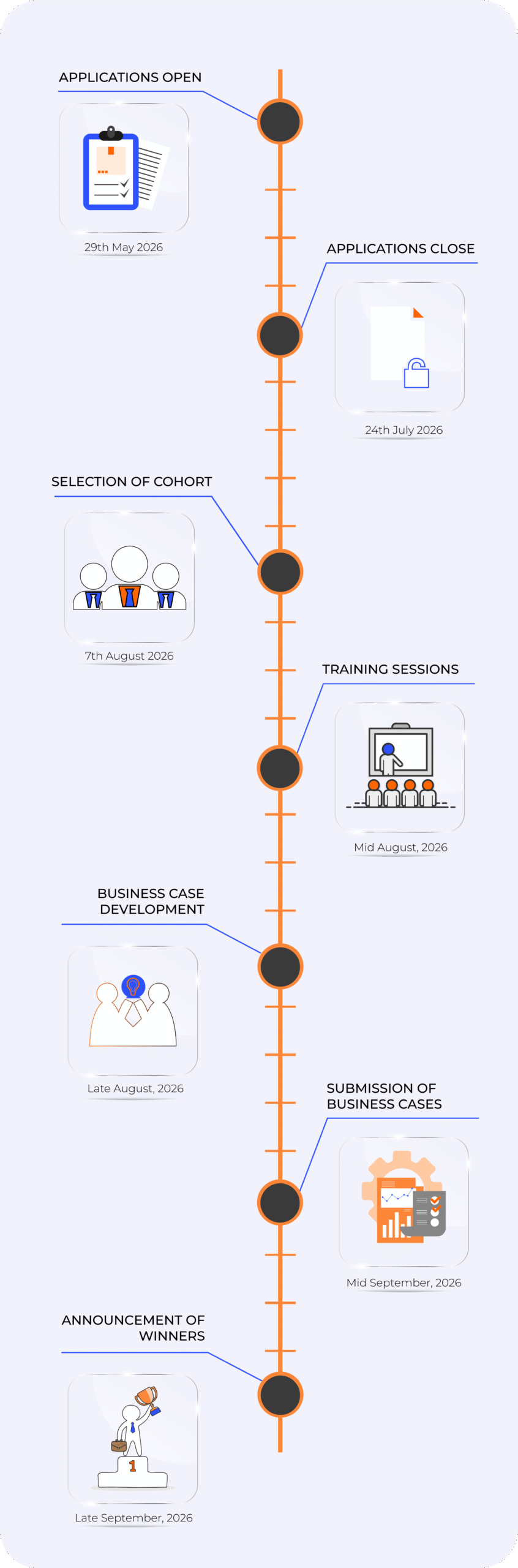
TIMELINE

ElectronVibe 2025 Cohort

BSES Rajdhani Power Limited (BRPL) Track

Gujarat Urja Vikas Nigam Limited (GUVNL) Track

our partners

Ecosystem Partner

Supported By

Knowledge Partner

Utility Partners

Outreach Partners

Program Partners

Utility Partners

Outreach Partners

JURY AND MENTORS

The jury and mentors for ElectronVibe 2025 are made up of a handful of power sector experts, utility officers from GUVNL and BRPL that will actively participate in the program

BRPL Juries
  • Adarsh Nagarajan, Strategic Initiatives Advisor, BRPL
  • Ajay Rawat, General Manager, Director Cell, BRPL
  • Avinash Kumar, Additional Vice President, BRPL
 
GUVNL Juries
  • D Y Harsora, Deputy Engineer, Technical Department, GUVNL
  • Kandarp B. Mistry, Deputy Engineer, C-NET, GETRI
  • Nagajan Parmar, Executive Engineer, Energy Storage System Department, GUVNL
  • Sachin Rathod, Junior Engineer, GUVNL
Mentors (BRPL):
  • Mr. Adarsh Nagarjan, Strategic Initiatives advisor, BRPL
  • Mr. Ajay Rawat, General Manager, Director Cell, BRPL
  • Mr. Avinash Kumar, Additional Vice President, BRP


Mentors (GUVNL):
  • Mr. D Y Harsora, Dep. Engineer, Technical Department, GUVNL
  • Mr. Kandarp Mistry, Dep. Engineer, C-NET, GETRI
  • Mr. Nagajan Parmar, Executive Engineer, Energy Storage System Department, GUVNL
  • Mr. Sachin Rathod, Junior Engineer, GUVNL
BRPL Jury:
  • Mr. Adarsh Nagarjan, Strategic Initiatives advisor, BRPL
  • Mr. Ajay Rawat, General Manager, Director Cell, BRPL
  • Mr. Avinash Kumar, Additional Vice President, BRPL

GUVNL Jury:
  • Mr. Chandrakant Pendor, AGM-IT, GUVNL
  • Mr. Dharmeshkumar Olakiya, SE Technical, GUVNL
  • Mr. Krushna Dhandal, Senior Manager IT, GUVNL
  • Mr. Nagajan Parmar, Executive Engineer - PSP , GUVNL
  • Mr. Sumit Harwani, Deputy Engineer - PSP, GUVNL